← All daily discoveries
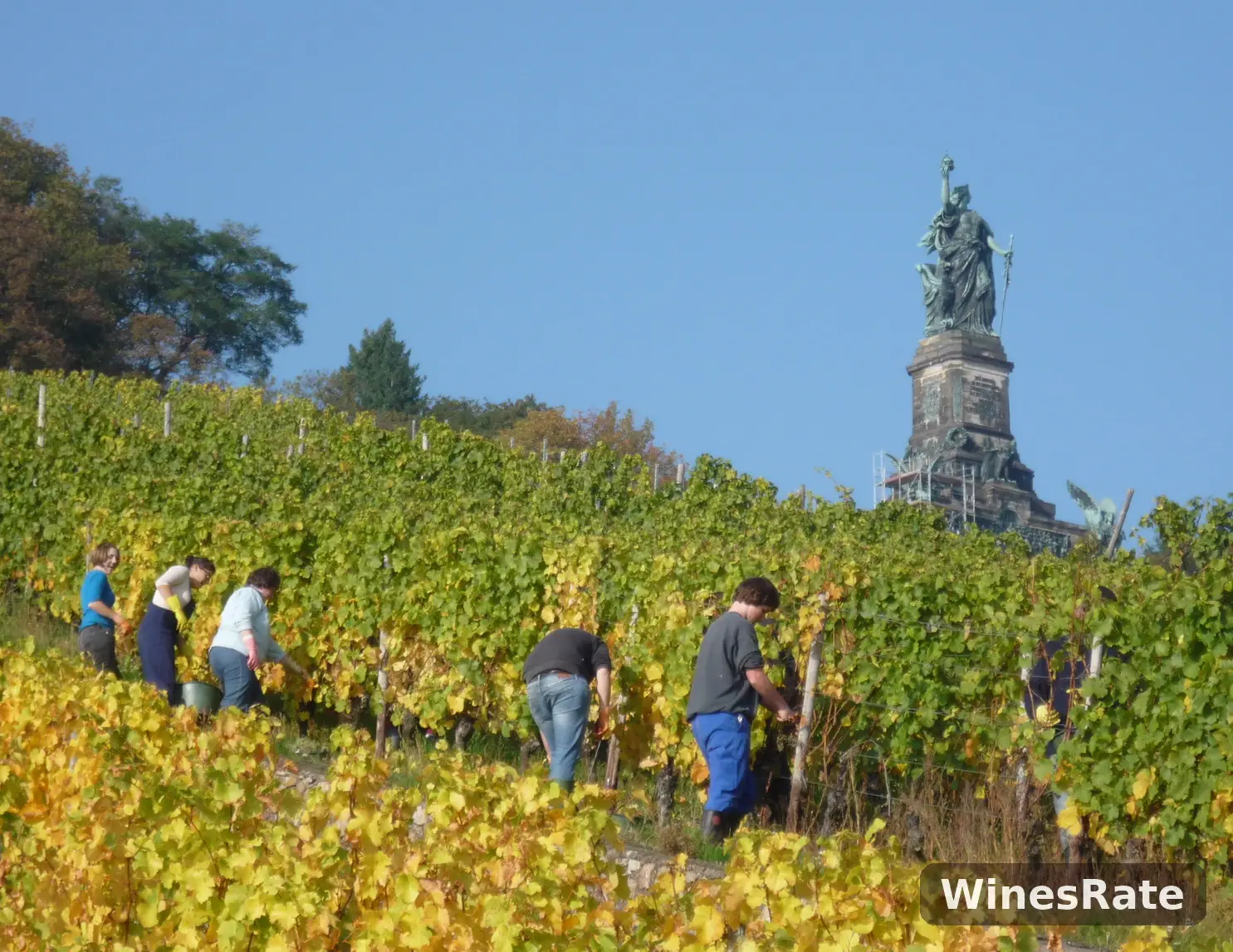
Grape pickers harvesting Riesling in the steep vineyards below the Niederwalddenkmal monument above Rüdesheim on the Rhine

WinesRate Guide

Rheingau Wine Region Guide: Riesling, Kloster Eberbach, Rüdesheim & How to Plan Your Visit

One river bend, one grape done to perfection, and nine centuries of monks, castles and steep slate slopes. Every fact below was checked on 28 November 2026 against the region's own monastery winery, Kloster Eberbach, and the Hesse tourism board — including the honest gaps, where tasting prices are simply not published.

Wiesbaden–Lorch · Rhine's right bankGrape: RieslingMonastery: Kloster Eberbach, 1136Walk: Rheinsteig, 320 km
Photo: Grape harvest below the Niederwalddenkmal, Rüdesheim, by Pedelecs — CC BY-SA 3.0, via Wikimedia Commons.
Eltville — largest town wine promenade →Kloster Eberbach — abbey since 1136 →Johannisberg — Spätlese born 1775 →Rüdesheim — river town Drosselgasse

The short answer: can you do the Rheingau in a day?

Yes — and a day is enough to fall for it, though a weekend does it justice. The Rheingau is a compact strip of vineyards along the right bank of the Rhine, from Wiesbaden in the east to Lorch in the west, with Rüdesheim at its western end. Trains run along the river from Frankfurt and Wiesbaden, boats serve the riverside towns, and the wine villages sit minutes apart — so you can base yourself in one town and taste your way along the slope without ever needing to drive.

The region is, above all, Riesling country. The grape dominates the south-facing slopes that the Rhine's westward bend turns towards the sun, sheltered by the Taunus hills behind them. The exception proves the rule: around Assmannshausen, the valley cuts away from the river and the purple slate slopes grow Spätburgunder (Pinot Noir) instead — the Rheingau's famous red corner.

1136
Kloster Eberbach
monastery founded
1775
Spätlese
born at Johannisberg
65%
Berg Schlossberg
steepest slope
7.5
ha St Hildegard
the nuns' winery

One honest limit before you plan: tasting prices are not published on the monastery winery's own pages checked on 28 November 2026. This guide tells you what each place is, when it is open where that is published, and what to ask for — and flags where you need to check the estate's own site before you go.

The villages, east to west

The Rheingau runs in a single line along the river. Start at one end and work along it — every village below is a stop on the same slope.

PlaceWhat it isWhy stop
Eltville The Rheingau's largest town, on the Rhine promenade. The practical base: the biggest choice of places to stay and eat, and the start of the walk up to Kloster Eberbach.
Kiedrich A hillside wine village above Eltville. Quiet lanes, old wineries and the climb towards the abbey — the Rheingau at its most village-like.
Hattenheim Wine village below the Steinberg vineyard. Evening tastings at the wine barrel on the riverbank, and the foot of the monastery's great walled vineyard.
Johannisberg The hill where Spätlese was born in 1775. Schloss Johannisberg, its restaurant and its view — the single most historic vineyard address in Germany.
Geisenheim University town of wine, below Johannisberg. Home of the Geisenheim wine university — the science behind the region's Riesling.
Rüdesheim The lively river town at the region's western end. The Drosselgasse, the cable car up to the Niederwalddenkmal, and the gateway to the Rhine Gorge.
Assmannshausen Red-wine village in a side valley. Spätburgunder from the steep, purple-slate Höllenberg — the Rheingau's other grape, in its own valley.

🗺 The shape of the region: the Rhine turns west for about 30 kilometres between Wiesbaden and Rüdesheim, and the south-facing slopes along that bend are the Rheingau. The Taunus hills shelter the vines from the north, the river reflects light and warmth back onto them, and the slate and quartzite soils drain fast — the three facts that explain why Riesling ripens here at all, this far north.

Why the Rheingau matters: monks, a late courier and steep slate

Three stories explain this region — and all three are still visible in the landscape today.

Monks — since 1136

Cistercian monks founded Kloster Eberbach in 1136 and built the region's wine trade. They owned the Steinberg vineyard since 1239 — their favourite site — and walled it with a three-kilometre wall in the 18th century to keep out grape thieves. The abbey is now one of the best-preserved medieval monasteries in Germany, home to the Hessen State Wineries and a venue of the Rheingau Music Festival.

Spätlese — born 1775

At Schloss Johannisberg, legend says a messenger took so long delivering the prince-abbot of Fulda's permission to harvest in the autumn of 1775 that the grapes had already gone rotten. They were pressed anyway, the wine tasted so good the following spring that 1775 became the official birth year of Spätlese — late harvest. The statue of the late courier, the Spätlesereiter, still stands at the castle.

Steep slopes — up to 65%

The Rüdesheimer Berg is the region's steepest ground. The Berg Schlossberg vineyard climbs at 65%, held up by imposing vineyard walls, on Taunus quartzite and phyllite slate beneath the ruins of Ehrenfels Castle. The Berg Rottland runs to 50% on weathered grey slate, quartzite and sandstone. These are hand-worked vineyards — no machine can climb them.

The Gorge — UNESCO

Rüdesheim sits at the southern end of the Rhine Gorge, the UNESCO World Heritage stretch of the Middle Rhine. The same river that warms the vines carries the castles, the gorge and the cruise boats — so a Rheingau trip naturally continues downriver, by boat, into the gorge itself.

What to taste: Riesling by vineyard, and the red exception

Taste by place, not by label. The Rheingau's great vineyards each have a character the monks mapped centuries ago — and the monastery's own vineyard pages still describe them site by site.

SteinbergHattenheim

The walled vineyard the monks loved best

The Steinberg has belonged to Eberbach Abbey since 1239, and the monks already counted it their favourite vineyard. Its oldest parcel, the Zehntstück, was planted before the monastery was founded in 1136. The south-facing slope runs through three soils — Taunus slate, quartzite and loess loam — and its top parcels carry the VDP's highest classifications.

MarcobrunnErbach

One of the oldest monastic vineyards

Erbach's Marcobrunn, documented since 1390, is one of the oldest monastic vineyards in the region. It grows on a south-facing slope of loess and calcareous clay marl, with a gradient of up to 25%, and takes its name from the classicist fountain on the border between Hattenheim and Erbach. It is the quiet classic: less famous than the Steinberg, just as old.

Rüdesheimer BergRüdesheim

The steep, stony, sun-baked end of the region

Above Rüdesheim the vineyards turn steep and stony. The Berg Roseneck climbs to 233 metres on reddish slate and quartzite; the Berg Rottland is hot and stony with skeletal soils; the Berg Schlossberg is the steepest of all at 65%. Taste these three side by side and you will understand what “site” means in the Rheingau: same grape, same river, three different wines.

HöllenbergAssmannshausen
🍷 The red Rheingau · Spätburgunder

The valley that grows red wine

Assmannshausen sits in a valley cut away from the Rhine, south-facing and sheltered, warm by day and cool morning and evening thanks to the nearby Taunus. Its Höllenberg vineyard, on purple slate and held by terraces and stone walls, grows Spätburgunder (Pinot Noir) with a character found nowhere else in the region.

When to go: the wine year on the Rhine

The right month depends on whether you want blossom, festivals, harvest, or quiet.

Apr–MaySpring

Budburst and the first tastings

Spring brings the vines back to life and the wine villages back outdoors. It is the quietest good season: estates are open, the river is calm, and the Rheinsteig is at its greenest.

Jun–AugSummer

Festivals, boats and long evenings

Summer is festival season — the Rheingau Music Festival fills Kloster Eberbach and the region's churches and castles, the river boats run at full timetable, and the wine taverns spill onto the riverbank. Book ahead: this is the busiest season.

Sep–OctHarvest

The harvest, and the photograph at the top of this page

September into October is the grape harvest — the photograph at the top of this page was taken during the Weinlese below the Niederwalddenkmal. The vineyards turn gold, the air smells of must, and the wine festivals of the autumn celebrate the young wine. This is the best time to see the region working.

Nov–MarQuiet season

Quiet slopes, open cellars

Winter is quiet and the river mists roll in, but the estates and the abbey are still there — and the Christmas run-up brings the cable car back into service over the vineyards. Check opening hours before you go, as smaller producers keep shorter winter hours.

A day in the Rheingau — and a slower weekend

The classic day is a line, not a loop: start east, finish west, and let the river carry you home.

Day tripTrain + walk

Eltville, the abbey, Rüdesheim

Take the morning train to Eltville and walk the river promenade. Then climb — on foot or by bus — to Kloster Eberbach, the abbey the monks built in 1136, and taste in its vinothek. In the afternoon, continue west to Rüdesheim: the Drosselgasse, the cable car up to the Niederwalddenkmal over the vineyards, and a last glass looking down the Rhine. Train home from Rüdesheim.

Day 1East

Eltville and the abbey, slowly

Base yourself in Eltville. Morning on the promenade and in the old town, afternoon at Kloster Eberbach with a guided tasting if one is running, evening at the wine barrel in Hattenheim as the boats pass on the river.

Day 2West

Johannisberg, Geisenheim, Rüdesheim

Morning at Schloss Johannisberg — the Spätlese story, the statue of the late courier, the view from the terrace. Then down to Geisenheim and on to Rüdesheim for the afternoon: the cable car, the monument, the Drosselgasse, and a tasting of the steep-slope Rüdesheimer Berg wines.

Costs & getting there: practical answers

Everything below is from the official sources listed at the foot of the page — including the prices we could not verify.

🎟 Costs

  • Tastings: tasting prices are not published on Kloster Eberbach's own pages checked on 28 November 2026. Check each estate's site before you go — and expect to book guided tastings in advance, especially at weekends.
  • Kloster Eberbach: the abbey itself is open to visitors daily, and its vinothek and wine bar serve glasses to walk-in visitors. Guided tastings are scheduled seasonally.
  • Cable car: the Rüdesheim cable car runs over the vineyards to the Niederwalddenkmal in the warmer months and in the Christmas run-up. Check the operator's current fares before you go.
  • Budget: the region is an easy day trip from Frankfurt, so the main costs are the train, one or two tastings and lunch — there is no entry ticket to the Rheingau itself.

📍 Getting there & around

  • By air: Frankfurt Airport sits just south-east of the region — the closest international gateway.
  • By train: trains run along the right bank of the Rhine from Frankfurt and Wiesbaden to Eltville, Geisenheim, Rüdesheim and Assmannshausen. Check live times on the day, as engineering works can replace trains with buses.
  • By boat: KD Rhine boats and smaller operators serve the riverside towns in the warmer months, and ferries cross the Rhine to Bingen — the river is a transport route, not just a view.
  • On foot: the Rheinsteig runs 320 kilometres from Wiesbaden to Bonn, passing Kloster Eberbach, Schloss Vollrads, Marienthal and the Niederwalddenkmal. The 30-kilometre stretch from Rüdesheim-Aulhausen to Eberbach Abbey alone passes six monasteries.
  • By car: the A66 from Frankfurt and the B42 along the river serve the region — but if you are tasting, take the train.

Keep planning with WinesRate

Before you go, browse the regions you'll be tasting: start from the WinesRate homepage, explore wine regions — 190 regions across 17 countries, read our slow weekend in another German wine valley in the Mosel travel journal, and look up the grapes in our wine grapes guide. WinesRate doesn't sell alcohol and publishes no ratings or scores — just real prices from real stores.

Frequently asked questions

The questions readers ask about the Rheingau wine region, answered from the verified details above.

Where is the Rheingau, and how do I get there?

The Rheingau is a strip of vineyards along the right bank of the Rhine in Hesse, Germany, running from Wiesbaden in the east to Lorch in the west, with Rüdesheim at its western end. Fly into Frankfurt Airport, just south-east of the region, then take the train along the river to Eltville, Geisenheim or Rüdesheim. Boats serve the riverside towns in the warmer months, and the Rheinsteig hiking trail links the villages on foot.

What wine is the Rheingau famous for?

Riesling — the grape dominates the region's south-facing slopes, from dry (trocken) wines to the noble-sweet Prädikat styles from Kabinett through Spätlese and Auslese. The exception is Assmannshausen, where the purple-slate Höllenberg vineyard grows Spätburgunder (Pinot Noir) instead.

Can I visit Kloster Eberbach and taste wine there?

Yes. Kloster Eberbach, founded in 1136, is open to visitors, and its vinothek and wine bar serve glasses to walk-in visitors. The abbey is one of the best-preserved medieval monasteries in Germany and the headquarters of the Hessen State Wineries. Guided tastings run seasonally — check the abbey's own site for current times and prices, which are not published on the pages we checked on 28 November 2026.

What is Spätlese, and where was it born?

Spätlese means “late harvest” — wine made from grapes picked later than usual, riper and sweeter. According to legend, it was born at Schloss Johannisberg in 1775, when the messenger carrying the prince-abbot of Fulda's permission to harvest arrived so late that the grapes had gone rotten with noble rot. They were pressed anyway, and the wine tasted so good the following spring that 1775 became Spätlese's official birth year. The statue of the late courier, the Spätlesereiter, still stands at the castle.

When is the best time to visit the Rheingau?

It depends on what you want. September to October is the harvest — the vineyards turn gold and the region is working at full pace. Summer brings the Rheingau Music Festival at Kloster Eberbach, full boat timetables and the liveliest taverns. Spring is the quietest good season, and winter is quiet and misty, with shorter hours at smaller producers. Check opening hours before a winter visit.

Do I need a car in the Rheingau?

No — and you are better off without one if you are tasting. Trains run along the river from Frankfurt and Wiesbaden to the wine villages, boats serve the riverside towns, the Rheinsteig trail links the villages on foot, and Rüdesheim itself is small enough to cover walking. A car is only useful if you want to reach the smallest hillside estates — and then the driver tastes nothing.

Sources & how this page was made

Checked on 28 November 2026 against the official sources below:

  • Kloster Eberbach — “Our vineyards” (kloster-eberbach.de/en/wein/unsere-weine/unsere-weinberge): monastery founded 1136; Steinberg owned since 1239, three-kilometre 18th-century wall, Zehntstück planted before 1136; Marcobrunn documented since 1390; Neroberg just under 4 hectares; Assmannshausen Höllenberg purple slate and Pinot Noir; Berg Roseneck to 233 metres; Berg Rottland gradient up to 50%; Berg Schlossberg 65% slope and Ehrenfels Castle ruins; Hochheim Domdechaney and the 1706 wine.
  • Hessen Tourismus — “Wine Hikes and Religious Sites” (en.hessen-tourismus.de): St Hildegard Abbey above Rüdesheim, 7.5-hectare winery, around 50,000 bottles a year; Rheinsteig 320 kilometres from Wiesbaden to Bonn, 30-kilometre stretch Rüdesheim-Aulhausen to Eberbach Abbey passing six monasteries; Drosselgasse live music and wine-barrel sleeping; Schloss Johannisberg and the 1775 Spätlese legend; Eberbach Abbey as one of Germany's best-preserved medieval monasteries, venue of the Rheingau Music Festival and headquarters of the Hessen State Wineries.
  • WinesRate (winesrate.com): homepage, Regions, Mosel travel journal and Grapes pages — linked in “Keep planning” above and verified live on 26 November 2026.

The topic came from current social and trade conversation about European wine regions to visit. This page is original WinesRate content: every word was written for WinesRate, all facts were re-verified from the sources above, and no text, image or video was copied from any post or creator. The only photograph used is the CC BY-SA 3.0 Wikimedia Commons image credited in the hero. WinesRate does not sell alcohol and publishes no ratings or scores.

This guide lives at winesrate.com/discover/rheingau-wine-region/ · Prepared 28 November 2026.